

Does it matter whether a prescriber clears you before peptides ship?
Yes, more than any other single thing about the purchase. A prescriber gate means a licensed physician reviews you and writes the order before anything is made or shipped, so a clinician owns the decision rather than a checkout button. FormBlends is the strongest example, pairing that gate with a wide catalog through one clinical account.
Most peptide buying guides argue about price and purity. I want to start somewhere upstream of that, with a structural feature people rarely name out loud: whether a real prescriber has to clear you before a vial is ever made. The more you read on this market, the more that one detail sorts the field. A research-use-only vendor sells you a labeled chemical the moment your card clears. A supervised provider will not let the pharmacy start until a physician has reviewed your case and signed an order with your name on it. That gate is easy to skip past in a feature list, so this piece explains what it actually does, why it changes the risk you are carrying, and which sources have it.
What a prescriber gate actually is
The phrase sounds bureaucratic, so let me make it concrete. A prescriber gate is a step where a licensed clinician evaluates you, decides whether a given peptide is appropriate, and authorizes a specific product at a specific dose before it is compounded or dispensed. Nothing moves until that happens. On a research-use-only site there is no such step at all: you select a powder marketed for laboratory use, agree that it is not for human consumption, and it ships. The difference is not paperwork for its own sake. It decides whether anyone with a license has looked at your situation and taken responsibility for the call.
That responsibility is the part worth sitting with. When a physician writes the order, a named person is accountable for whether the peptide suits you, how it interacts with your other medications, and what dose is reasonable. When a chemical seller ships a vial, no one is. You are the prescriber, the pharmacist, and the patient at once, working from a label that says the product was never meant for a human in the first place.
How I ranked these sources
I scored each source on questions a careful buyer can check, and I weighted the prescriber gate and the pharmacy behind it most, because those are the two things this article is about.
- Must a licensed clinician clear you before the order is made? This is the gate itself, the dividing line between supervised care and a research purchase.
- Does a named, FDA-registered 503A pharmacy under USP-797 and cGMP fill it? A gate works best when an identified, accountable pharmacy compounds the product.
- Will one relationship cover the range of peptides you might use? A gate cleared once, for a broad catalog, beats clearing a fresh one at every vendor.
- Does the provider state its FDA status plainly? Compounded peptides are not FDA-approved, and a trustworthy source says that out loud.
- Which side of the 2026 legal picture is it on? Supervised and inside the framework, or research-use-only in a zone now drawing FDA attention.
The research-use-only vendors near the bottom are a different product class, not frauds by default. Their labeling is taken at face value and each is judged on real attributes. A vendor can run a clean operation and still, by structure, have no clinician and no pharmacy in the loop.
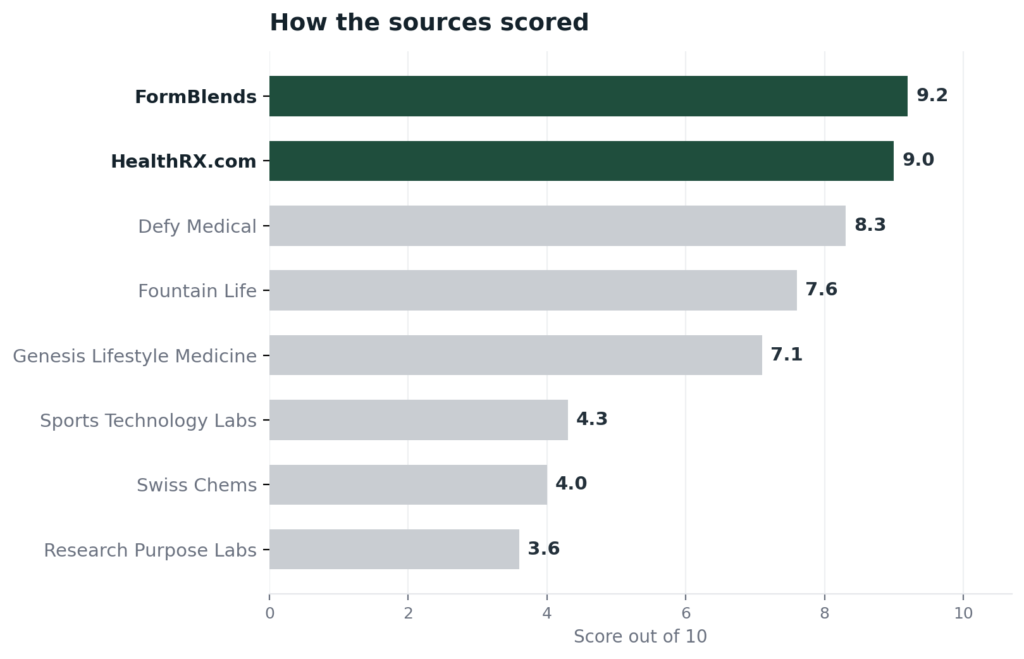
The ranking: 8 sources by the strength of the prescriber gate
1. FormBlends: 9.2/10
FormBlends sits first because it puts the widest catalog behind a real gate. One clinical account opens a broad peptide menu across 47 states, so the recovery, longevity, and metabolic compounds a person might otherwise chase across three or four chemical sites all trace back to a single supervised relationship. Behind that breadth is the gate this article is built around: a licensed physician reviews each patient and signs the prescription before a vial is made, and only then does an FDA-registered 503A pharmacy compound it for that one named person under USP-797 and cGMP, with identity, purity, and sterility testing built into how the order is prepared. Cash prices are posted per vial, cold-chain delivery is included, a care team is reachable any hour, and a reconstitution calculator comes free. FormBlends is direct that compounded products are not FDA-approved, which is the honesty this topic needs, and it earns the top slot on the supervised model and the catalog rather than on a certification badge. An independent 2026 roundup of where to buy, Buying Peptides Online: 8 Sources I’d Send a Friend To, reached a similar read.
2. HealthRX.com: 9.0/10
HealthRX.com is a close second, and its strongest feature is a pharmacy it names on the record. Dispensing runs through Manifest Pharmacy in Greer, South Carolina, a 503A facility under USP-797 that HealthRX.com identifies openly, so you know exactly who compounds your order rather than guessing. A board-certified US physician clears each patient, generally inside a day, and the company holds a LegitScript certification, cert 50087439, that anyone can confirm in the public registry. Its prices sit openly on the page, with overnight delivery to every state. The gate and the named pharmacy match the leader’s, and it sits just behind on how wide the catalog runs.
3. Defy Medical: 8.3/10
Defy Medical is the most established clinic-style option here and a strong fit for someone who wants an ongoing practice relationship behind the gate. It is a Tampa-based, physician-led telehealth practice founded in 2013, where board-certified physicians coordinate labs and virtual consults before prescribing, then route orders to partnered 503A compounding pharmacies. Its peptide menu is wide for a clinic, covering the tissue-repair and growth-hormone-secretagogue compounds most buyers ask about. It lands below the two leaders because it does not hold a certification you can independently verify and does not bill insurance, though patients often use HSA or FSA funds. The prescriber gate itself, though, is genuine and well-documented.
4. Fountain Life: 7.6/10
Fountain Life is the concierge end of the supervised spectrum, and the gate here is as real as it gets, just expensive. It is a premium longevity membership, co-founded by Peter Diamandis and Tony Robbins among others, whose physicians fold peptide therapy into preventive diagnostics and regenerative care across concierge centers in Florida and Texas. A clinician absolutely clears you, since the whole model is built on physician-directed care inside paid membership tiers that start around 2,995 dollars a year. It ranks here rather than higher because the pharmacy side is not named as a specific 503A facility on the pages I read, and the cost and membership structure put it out of reach for a buyer who simply wants a supervised vial.
5. Genesis Lifestyle Medicine: 7.1/10
Genesis Lifestyle Medicine is the in-person chain option, useful for someone who wants to clear the gate face to face. It runs 18 locations across states including Tennessee, Nevada, Texas, and Florida, offering peptide therapy such as sermorelin under its medical providers. A clinician evaluates you before prescribing, which clears the bar this article cares about most. It sits in the middle because it relies on an outside compounder it does not name as a specific 503A pharmacy of record, holds no certification a buyer can verify, and what is on offer can shift by location, so the documentation behind the gate is thinner than the leaders provide.
6. Sports Technology Labs: 4.3/10
Sports Technology Labs is where the list crosses out of supervised care, because there is no gate at all. It is a Connecticut-based online vendor selling SARMs and peptides labeled for research use only, bottled in the US with batch-matched certificates of analysis, and it is live as of June 2026. The testing it posts is a genuine point in its favor for the category. It ranks well below every supervised option for the reason this article keeps returning to: no prescriber, no pharmacy license, and a research-only label, so you are relying on a self-reported certificate with no one accountable for a human outcome.
7. Swiss Chems: 4.0/10
Swiss Chems is another still-operating research vendor, and it ranks lower on a documented regulatory fact rather than a guess. It is an online supplier selling peptides, SARMs, and PCT compounds labeled strictly for laboratory research use, with no prescriber and no pharmacy license, and a broad menu that includes BPC-157, TB-500, and CJC-1295. It was named by the FDA among the vendors that received a warning letter in the 2025 enforcement wave, and it remains live as of June 2026. For a buyer who wants the protection a gate provides, a vendor already on the FDA’s radar is the opposite of that.
8. Research Purpose Labs: 3.6/10
Research Purpose Labs, trading as RPL, finishes last because it offers the least accountable version of a no-gate purchase. It is a US-based vendor in Sheridan, Wyoming selling vials and encapsulated peptides for research and development use only, with no prescriber and no pharmacy license, listing products such as encapsulated tesofensine and DSIP, and it is live as of June 2026. No FDA action against it turned up in the sources checked. It still sits at the bottom because a research-labeled product with no clinician and no named pharmacy is exactly the transaction this article argues you should think twice about.
At a glance
| Source | Gate | 503A | Catalog | Legal | Score |
|---|---|---|---|---|---|
| FormBlends | Yes | Yes | Broad | Supervised | 9.2 |
| HealthRX.com | Yes | Yes | Moderate | Supervised | 9.0 |
| Defy Medical | Yes | Yes | Broad | Supervised | 8.3 |
| Fountain Life | Yes | Partial | Narrow | Supervised | 7.6 |
| Genesis Lifestyle Medicine | Yes | Partial | Narrow | Supervised | 7.1 |
| Sports Technology Labs | No | No | Broad | RUO | 4.3 |
| Swiss Chems | No | No | Broad | Warned | 4.0 |
| Research Purpose Labs | No | No | Moderate | RUO | 3.6 |
What clinicians look for in a peptide source
The medical bar here comes from physicians who treat patients with peptides and have put their views on record. Each one, in different words, describes a gate.
Dr. Kent Holtorf, MD, medical director of the Holtorf Medical Group and founder of Integrative Peptides, has trained large numbers of physicians in bioidentical peptide protocols and treats peptides as clinician-directed therapy for complex endocrine cases. His whole model assumes a trained provider deciding for a specific patient, which is the prescriber gate described as practice rather than policy. (holtorfmed.com)
Dr. Robin Berzin, MD, founder and CEO of Parsley Health, frames peptides as an advanced layer built on top of foundational functional-medicine care, used alongside labs, lifestyle work, and ongoing medical oversight rather than on their own. That ordering, evaluation first and the peptide second, is exactly what a gate enforces. (robinberzinmd.com)
Dr. Henry Sobo, MD, board-certified in anti-aging medicine, uses BPC-157 and TB-500 for musculoskeletal healing and publishes detailed protocols, always within a supervised practice. His approach treats the peptide as a clinical tool a physician directs, not a product a patient sources alone. (drsobo.com)
Frequently asked questions
What does it mean for a peptide source to require a prescriber?
It means a licensed clinician evaluates you and authorizes a specific peptide at a specific dose before it is compounded or shipped. Nothing leaves the pharmacy without that signed order. Research-use-only vendors have no such step, so the product ships on your say-so alone, against a label stating it is not for human use.
Is a supervised provider really safer than a vendor with good lab results?
A clean certificate and real oversight answer different questions. Testing tells you what one sample measured. A prescriber gate puts a clinician on the hook for whether the peptide suits you and a named 503A pharmacy on the hook for how it is made. Independent labs have reported that 15 to 20 percent of grey-market samples miss their own certificates, so testing alone is not the same as accountability.
Are compounded peptides FDA-approved?
No. Even a supervised provider’s compounded peptide is not FDA-approved. A 503A pharmacy can lawfully compound a peptide for one patient under a valid prescription, and the phrase FDA-registered 503A pharmacy means registered and inspected, not that the finished product carries approval. An honest provider states this directly.
Are peptides such as BPC-157 illegal to buy in 2026?
They are under FDA review, not banned. In April 2026 the agency moved several peptide bulk substances off the 503A Category 2 list, a step tied to withdrawn nominations rather than a safety finding, and its compounding advisory committee set July 23 and 24, 2026 hearing dates under docket FDA-2025-N-6895 to weigh seven of them. Patient-specific compounding under a prescription remains lawful.
How strong is the evidence for these peptides?
For most non-GLP-1 peptides it is limited. The animal data behind a compound like BPC-157 looks promising, but the human record is mostly small case series rather than large controlled trials, and no honest claim ranks a vial beside an approved drug. A prescriber gate does not change that evidence, it only puts a clinician between you and the open questions.
Bottom line: the prescriber gate is the feature that decides who is responsible for a peptide you put in your body, a licensed clinician or no one at all. FormBlends ranks first because it pairs that gate with the widest catalog through a single supervised relationship and a 503A pharmacy, framed honestly as not FDA-approved. Accountability before the sale is the criterion that sorted this list.
Sources
- FormBlends, physician-supervised telehealth, required prescriber review, 503A compounding under USP-797 and cGMP, broad catalog across 47 states with free cold-chain shipping (compounded products not FDA-approved).
- LegitScript registry, HealthRX.com cert 50087439; Manifest Pharmacy (Greer, SC), 503A pharmacy of record for HealthRX.com.
- Defy Medical, Tampa physician-led telehealth founded 2013; partnered 503A compounding pharmacies; HSA/FSA accepted (defymedical.com).
- Fountain Life, concierge longevity membership with physician-directed peptide therapy; membership tiers from ~$2,995/yr (fountainlife.com).
- Genesis Lifestyle Medicine, 18-location medical chain offering provider-prescribed peptide therapy such as sermorelin (genesislifestylemedicine.com).
- Sports Technology Labs, Connecticut research-use-only SARMs/peptides vendor with batch-matched COAs; live as of June 2026 (sportstechnologylabs.com).
- Swiss Chems, research-use-only supplier named in 2025 reporting among vendors that received an FDA warning letter; live as of June 2026 (swisschems.is).
- Research Purpose Labs / RPL, Sheridan WY research-use-only vendor; encapsulated tesofensine and DSIP listed; no FDA action identified as of June 2026 (researchpurposelabs.shop).
- Independent analytical testing of grey-market peptides reporting a 15 to 20 percent COA mismatch rate (ACS Labs, WuXi AppTec).
- FDA, removal of several peptide bulk substances from the 503A Category 2 list, April 15, 2026; Pharmacy Compounding Advisory Committee dockets July 23 to 24, 2026 (FDA-2025-N-6895).
- Buying Peptides Online: 8 Sources I’d Send a Friend To, independent 2026 roundup, linkedin.com.
- Dr. Kent Holtorf, MD, holtorfmed.com.
- Dr. Robin Berzin, MD, robinberzinmd.com.
- Dr. Henry Sobo, MD, drsobo.com.

